Carbon isotopic
ratio at the surface of giant stars
- Lagarde
N., et al. 2024 A&A, 684, A70
“12C/13C of Kepler giant stars : the missing piece of the mixing puzzle”
Context:
Despite a rich observational background, few spectroscopic studies have dealt with the measurement of the carbon isotopic ratio in giant stars. However, it is a key element in understanding the mixing mechanisms that occur in the interiors of giant stars.
Results: We present a novel analysis of CNO abundances and the ^{12}C/^{13}C isotopic ratio for 71 field giant stars, derived using high-resolution spectra from the FIES spectrograph at the Nordic Optical Telescope.
The uniqueness of our study lies in:
(1)A multi-faceted dataset: Combining asteroseismic data (Kepler) for stellar masses, ages, and evolutionary states with astrometry (Gaia) to refine stellar properties.
(2)An investigation of internal mixing efficiency along the giant branch, as a function of stellar parameters (mass, age, metallicity).
To fully leverage this extensive catalog, we generated mock catalogs using the Besançon Galaxy Model, incorporating stellar evolution models that account for thermohaline instability. This approach enables us to explore both the impact of stellar evolution and the Milky Way’s chemical evolution on the observed abundances.
The carbon isotopic ratio measured at the surface of the core He-burning stars increases with [Fe/H] and stellar mass, while it decreases with stellar age. These trends are all nicely explained by the thermohaline mixing that occurs in red giants. We show that our models can explain the behaviour of ^{12}C/^{13}C versus N/O, although the observations seem to show a lower N/O than the models. We also note that more constraints on the thick disc core He-burning stars are needed to understand this difference.
Overall, the current model including thermohaline mixing is able to reproduce very well the ^{12}C/^{13}C with the stellar metallicity and with the stellar mass and age.
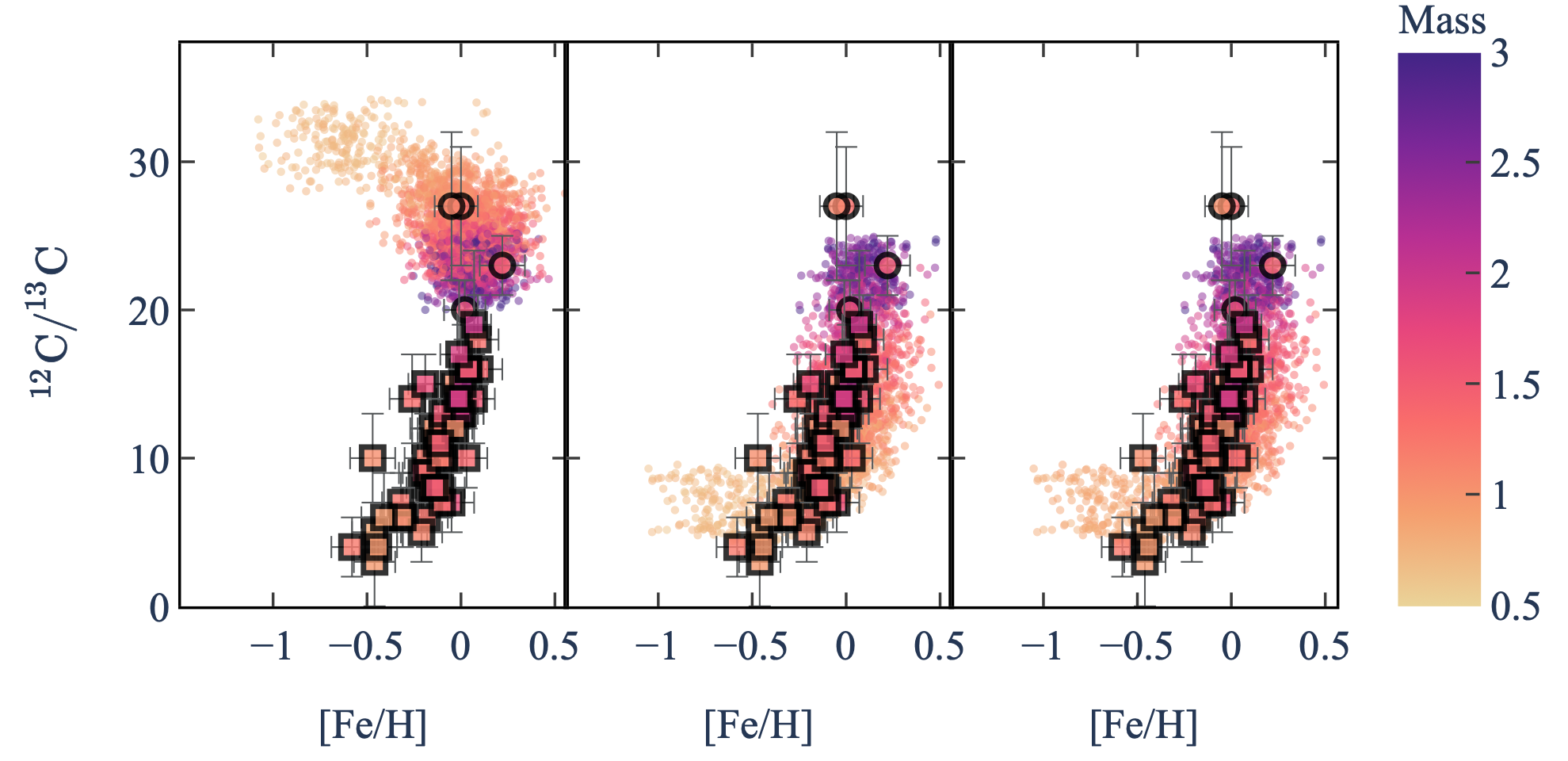 Fig.:
^{12}C/^{13}C
vs. [Fe/H] for core He-burning and
RGB stars in our sample (squares
and circles, respectively)
compared with the BGM simulations
for core He-burning stars only
(dots) of the Kepler field and
taking into account or not the
effects of thermohaline mixing
(right and left panels, respectively). The stellar mass is colour-coded for both observations (using seismic determinations from PARAM) and simulations
(predicted by BGM using STAREVOL stellar evolution models from Lagarde
et al. 2017, 2019). In the right
panel the mass loss rate is
decreased on the RGB by a factor of two compared to the left and middle panels (see text for details).
Fig.:
^{12}C/^{13}C
vs. [Fe/H] for core He-burning and
RGB stars in our sample (squares
and circles, respectively)
compared with the BGM simulations
for core He-burning stars only
(dots) of the Kepler field and
taking into account or not the
effects of thermohaline mixing
(right and left panels, respectively). The stellar mass is colour-coded for both observations (using seismic determinations from PARAM) and simulations
(predicted by BGM using STAREVOL stellar evolution models from Lagarde
et al. 2017, 2019). In the right
panel the mass loss rate is
decreased on the RGB by a factor of two compared to the left and middle panels (see text for details).